
Organise resources and collections around their origin and use. On import, existing information should be preserved and then completed according to your documentation model.
Solid foundations.
An open horizon.
Organise content. Bring knowledge together. Serve every business function.
Three distinct responsibilities for an architecture that evolves with you.
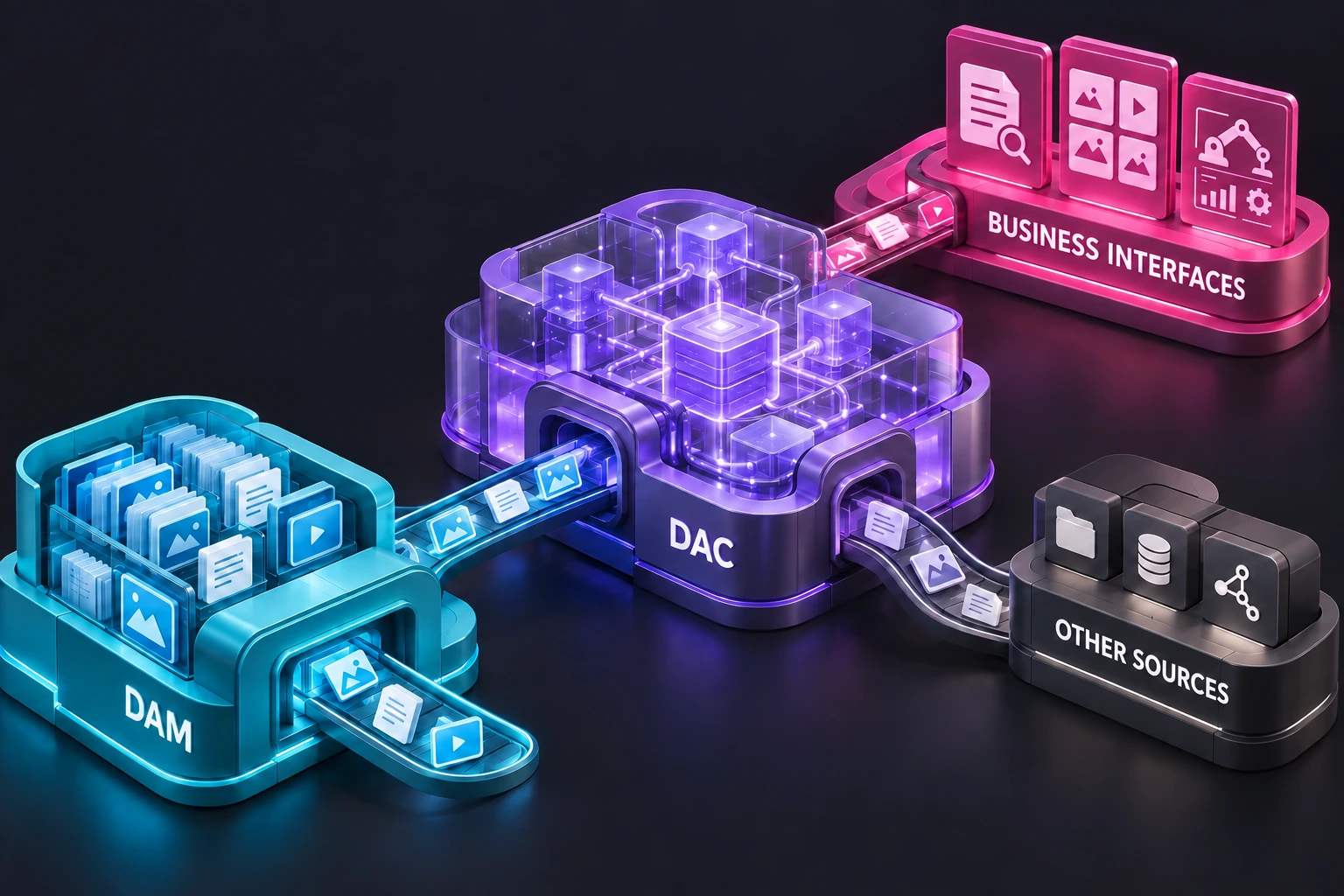
Connect without
moving everything.
The DAM (Digital Asset Management) governs the assets it is responsible for. Other sources feed directly into the DAC: your information system does not have to become a single repository.
The DAC (Digital Asset Companion) aims to separate knowledge from models. Business experiences use these foundations to address a specific need.
Target architecture · scope to be defined01
DAM / ORGANISE & GOVERN
Digital content becomes a trusted foundation.
The DAM (Digital Asset Management) is Alveos’s established foundation. It brings together content whose lifecycle the company wants to control: images, videos, documents, communication materials or technical resources. Its role goes beyond storing files: it gives each asset an identity, a description and usage rules.
The same resource can be found through several routes — collection, topic, product or business function — without multiplying copies. Teams share a reference point to know what exists, which version to consult and under what conditions content can be reused.
DAM · IN ACTION
01 / 04 · ILLUSTRATIVE WORKFLOW
All your content. All its richness.
Metadata, categories and reference frameworks make content understandable. A title and a few keywords are not always enough: author, product, campaign, site, language or effective date may be essential.
Versions, statuses and approval workflows distinguish a resource in preparation from content ready for use. This organisation makes collections easier to maintain and reduces ambiguity.
User permissions and distribution conditions must be defined separately. Being able to view an image does not necessarily mean it can be published in every channel or territory.
WHAT THE LAYER RECEIVES
Existing files, media, documents and metadata.
WHAT IT DELIVERS
Identified, structured, versioned and governed assets.
IN PRACTICE
A campaign image remains linked to its credit, version, language and distribution conditions. A technical instruction stays linked to its reference and status.
Its role in the whole
The DAM governs the content it is responsible for. It is not intended to replace every database and application in the company.
Alveos’s established foundation. Formats, volumes and enabled features are specified in the project scope.02
DAC / UNDERSTAND, FEDERATE & CONNECT
Knowledge becomes usable, wherever it lives.
The DAC (Digital Asset Companion) is the knowledge and AI connection layer. It builds on the DAM but can also federate authorised sources in your information system: documentation, SharePoint, PIM, ERP, business databases or APIs. Other sources connect directly to this layer; they do not have to pass through the DAM.
The aim is to make content understandable and usable in a specific context. An agent is not just looking for a file: it needs to know what it represents, which information is authoritative and whether the user can access it. The DAC supports this preparation, search and exposure of knowledge.
DAC · IN ACTION
01 / 04 · ILLUSTRATIVE WORKFLOW
Your sources stay connected.
Each connection defines accessible data, synchronisation frequency and how updates and deletions are handled. The business source remains identified; federating knowledge does not require a general migration.
OCR, transcription, visual descriptions and suggested metadata can make content easier to query. These processes become more useful with business vocabulary and validation of sensitive information.
Semantic indexing enables search based on the meaning of a request. In a RAG approach, selected sources then inform a model’s answer. References, versions and context remain essential for checking that answer.
APIs and MCP interfaces make it possible to assess appropriate access for knowledge consumers. User identity, permissions and the scope of actions must be controlled beyond the graphical interface alone.
WHAT THE LAYER RECEIVES
DAM content and knowledge from authorised sources.
WHAT IT DELIVERS
Documentary context usable by search, assistants, applications and agents.
IN PRACTICE
A request may bring together a DAM image, product information from a PIM and a brand rule from a document. Useful information is combined for the task without confusing its sources.
Its role in the whole
Knowledge must remain independent of the model using it. Changing LLM should not mean rebuilding the entire document collection. This independence must be designed and technically verified.
Target architecture. Connectors, models, enrichment and permission propagation are assessed and tested against sources and use cases.03
Business experiences / ADAPT & PUT INTO ACTION
The service fits your operational reality.
The third layer is what your users see and use. It turns DAM and DAC capabilities into a practical service: finding a resource, preparing a campaign, consulting an instruction, compiling a dossier or querying a knowledge base.
Alveos starts with business needs to design screens and interactions. Navigation, filters, approvals and tools are tailored to the task. Your organisation should not have to fit a fixed workflow or a template library that limits possible uses.
BUSINESS · IN ACTION
01 / 04 · ILLUSTRATIVE WORKFLOW
Business needs are the starting point.
Identify users, their constraints and the decisions they need to make. A communications team, a document specialist and an operator do not seek the same information, even when they share some sources.
Brand Center, document portal, partner space or shop-floor application: each experience brings together useful resources and tools. Business context reduces unnecessary steps and guides users.
An assistant can help formulate a search, point to a document or prepare content. It fits within the workflow and retains the necessary approval steps, particularly for operational instructions and publication.
Tailoring concerns the experience and its rules. It can build on proven technical components and shared foundations. Maintenance, accessibility, performance and future changes are included in scoping.
WHAT THE LAYER RECEIVES
DAM and DAC capabilities, user context and business rules.
WHAT IT DELIVERS
Interfaces and services adapted to teams, channels and usage situations.
IN PRACTICE
Marketing prepares a kit in a Brand Center. A document specialist explores a collection using its reference frameworks. An operator consults resources applicable to their workstation in a dedicated interface.
Its role in the whole
The front end does not replace data governance. It displays authorised information and relies on controls in the underlying services.
Tailored design. Workflows, integrations, equipment, maintenance and budget are defined together.From governed content
to a useful answer.
A resource is organised
The DAM retains the file, its description, version and rules. Other systems remain responsible for their own information.
Context becomes accessible
The DAC connects relevant sources, prepares them for use and selects knowledge useful to an authorised request.
Teams can act
The interface presents resources, suggests an answer or supports a task, with the necessary sources and approvals.
Value comes from continuity between these layers: documentation quality at the input, permissions preserved during exchanges and visible context at the output. This is the chain the pilot must test against your content and use cases.
Discover how to scope an initial use caseSTART WITH YOUR REALITYYour knowledge has potential.
Let’s discuss your project